
Herald оf Tver State University. Series: Philosophy
Current Issue
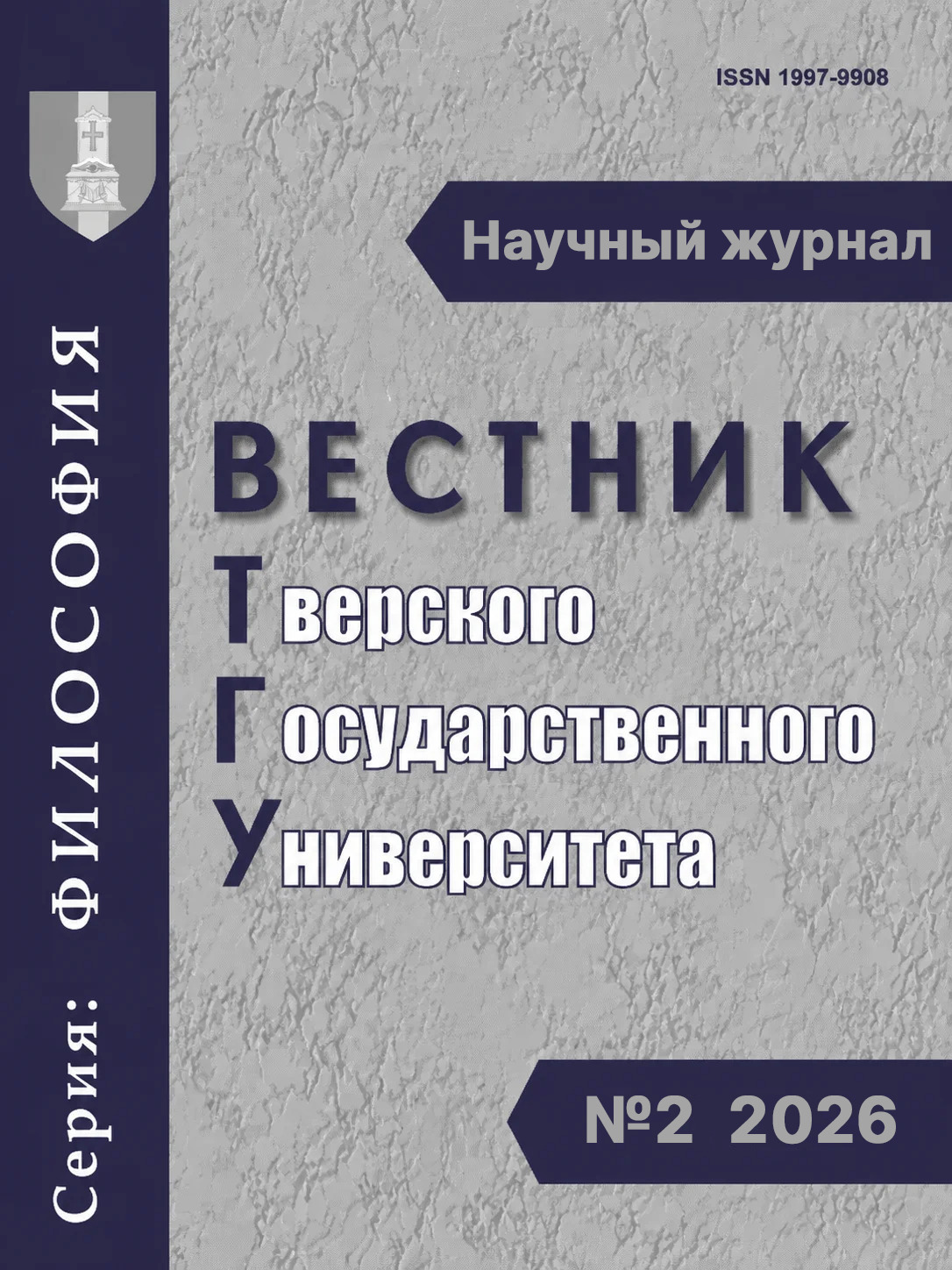
Issue 2nd of the journal for 2026 features articles by researchers on the history of philosophy, epistemology, and foreign and domestic thought.
In the “Man. Science. Culture” by E.A. Razova explores the constitutive Co‑Event in an era of crisis. The study by V.V. Ilyin, I.V. Ilyin, and K.V. Ilyin is devoted to the archaeology of creativity and the potential of apotheosis. The article by S.A. Lebedev and A.A. Alymova analyzes the empirical level of scientific knowledge. O.R. Sadovskaya examines the concepts of scientific truth proposed by S.A. Lebedev and R. Gear. Y.D. Granin’s article is devoted to the experience of a transversal rethinking of the concepts of “civilization” and “civilizations.” S.N. Klimov studies the political philosophy of General de Gaulle. P.N. Rodin examines issues related to Russia’s internal security. V.P. Maykova, E.M. Molchan, and S.A. Kharitonova analyze problems related to safety in tourism. A.A. Kovalev’s article examines economic warfare and sanctions coercion in the global financial and economic system. A.A. Kornienko and I.I. Shapovalov study alienation in the digital age. K.V. Anufrieva explores digital resurrection in modern culture. V.Yu. Lebedev and A.M. Prilutsky’s article examines the semiotics of Soviet family‑labor rituals. S.I. Sulimov studies the interaction between Muslim society and the secular state, using the example of the French colonial regime in Algeria.
In the section “Problems of Russian Philosophy,” E.E. Mikhailova examines the sociocultural significance of “living” sources of the past in the works of V.O. Klyuchevsky. In the article by Ya.V. Bondareva and A.V. Leonov, the socio‑Christian concept of war in the works of S.L. Frank is analyzed. K.V. Anufrieva and M.K. Zverev characterize S.L. Frank’s doctrine of the state as the body of society.
In the section “Foreign Philosophy: Tradition and Modernity,” V.V. Zhulev reinterprets the medieval reception of Aristotle’s “Politics.” In the article by E.A. Yumkina and V.V. Volkov, the doctrine of Empedocles is examined. The article by S.N. Koskov and M.A. Ivanenko examines immanent epistemology using the example of Avenarius, Mach, and Schuppe. N.V. Medvedev examines the role of the regulatory ideal in the scientific knowledge of I. Kant. E.A. Lvov and A.A. Guseva conduct a comparative analysis of the ontologies of the Eugen Rosenstock-Hussy and Martin Buber dialogue. V.P. Potamskaya interprets Deism and classicism in the history of A. Lovejoy's ideas. P.M. Barmin explores the phenomenological reduction in Suhrawardi's teaching.